
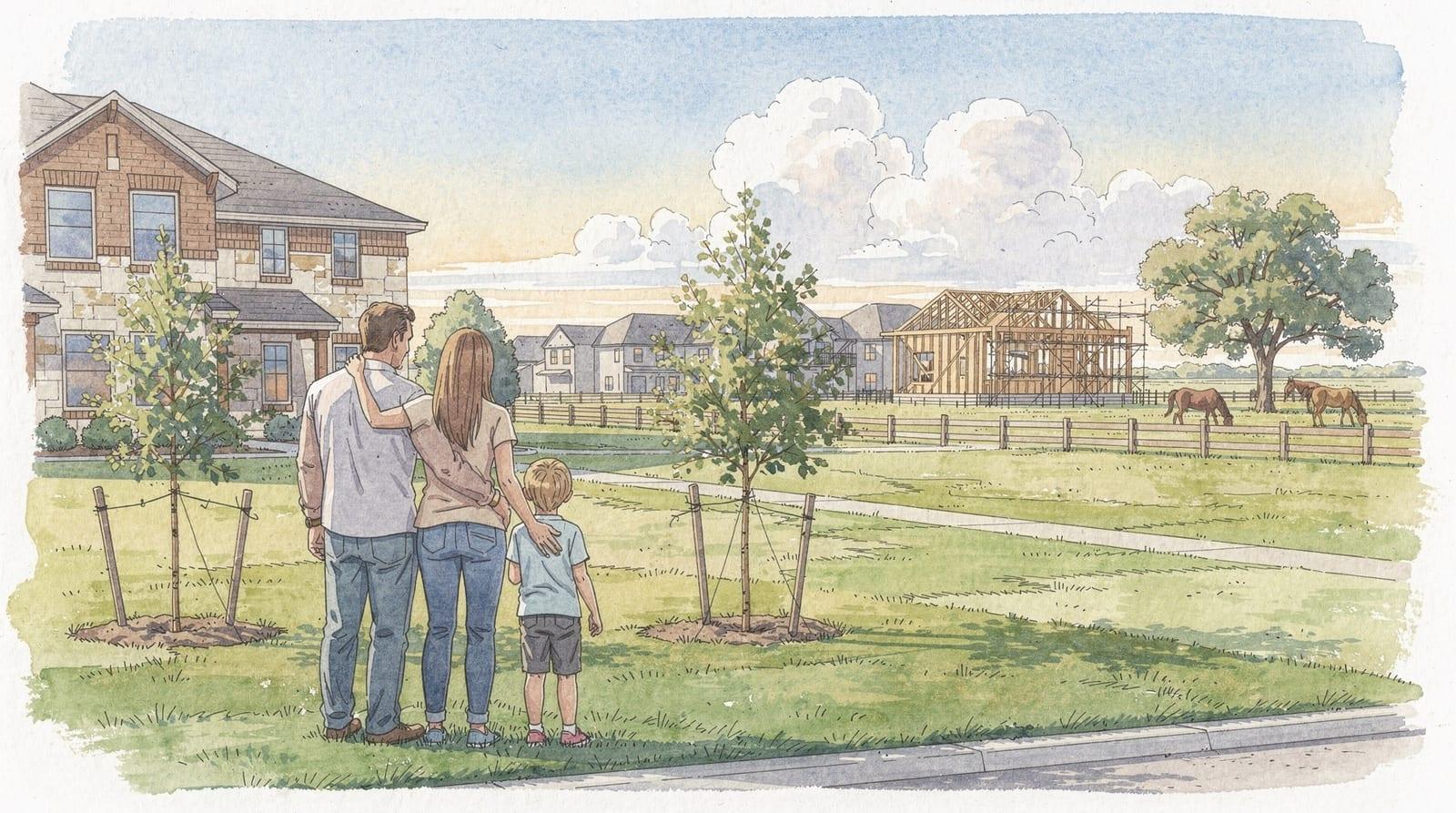
Fulshear is the old Fort Bend County farm town west of Houston where new master-planned communities have spread fast. This guide is for buyers comparing Fulshear with Katy, Richmond or the Houston suburbs closer in. It covers how fast the city has grown, how the 2026 property tax stack adds up, why so many homes here carry a MUD tax, which school districts serve Fulshear addresses, what is changing on the roads and the water supply, and what to check before you sign a builder contract or write an offer. Everything below was checked on November 15, 2026.
TL;DR
- Fulshear grew from 1,134 residents in the 2010 Census to 16,856 in 2020, and the U.S. Census Bureau estimates 64,630 as of July 1, 2025.
- For tax year 2026, the City of Fulshear adopted a rate of $0.190549 per $100, up from $0.167903. Add Fort Bend County, its drainage district and either Lamar CISD or Katy ISD, and the base is about $1.72 to $1.75 per $100 before any MUD.
- Many Fulshear-area homes also sit in a municipal utility district. On the Fort Bend County tax rate portal, 2026 rates for four local MUDs range from $0.71 to $1.12 per $100.
- Fulshear addresses are split between Lamar CISD and Katy ISD. Look up the exact address before you fall for a house.
- The city signed a long-term surface water deal in September 2026, and TxDOT's widening of FM 1463 between I-10 and FM 1093 is scheduled to finish in late 2026.
Fulshear in one paragraph: old crossroads, new rooftops
The Handbook of Texas places Fulshear at the junction of FM 359 and FM 1093 in northern Fort Bend County. It grew up around the plantation of Churchill Fulshear, one of Stephen F. Austin's Old Three Hundred colonists, and the town was laid out in 1890 after the railroad came through. For most of its history it was a farm town. That changed fast. Census figures show 1,134 people in 2010 and 16,856 in 2020, and the Census Bureau's 2025 estimate is 64,630. The same QuickFacts page reports a median owner-occupied home value of $572,700 and an owner-occupancy rate of 90.0% for 2020 to 2024. In plain terms, most buyers here are buying a fairly new single-family home, often from a builder.
Master-planned communities and the ETJ
Much of Fulshear's growth is inside large master-planned communities. The city's Major Development Map (2024) lists more than 20 of them across the city limits and the extraterritorial jurisdiction (ETJ). The largest by planned single-family lots include Cross Creek Ranch (6,298), Tamarron (4,740), Tamarron West (4,236), Cross Creek West (3,900), Firethorne (3,259), Jordan Ranch (3,000) and Fulshear Lakes (1,750). In total, the map counts 38,141 planned lots and units, with 27,463 developed when it was published.
The ETJ matters for your tax bill. The city's tax ordinance levies its rate only on property "within the corporate limits." A home with a Fulshear mailing address in the ETJ may not pay the city rate at all. Check the property record at the Fort Bend Central Appraisal District to see which taxing units actually apply.
New construction questions to ask
- Is the lot inside the city limits or in the ETJ?
- Which MUD is it in, and what is that district's current rate?
- What are the HOA dues, and is there a separate community association for amenities?
- Which school district and campuses is the address zoned to today?
Our guide to new construction vs. resale in Houston covers builder contracts, inspections and incentives in more detail.
The 2026 property tax stack, line by line
Fort Bend County's 2026 tax rate and exemption worksheet lists these adopted rates per $100 of taxable value:
- City of Fulshear: $0.190549, with a homestead exemption of 14% or $5,000, whichever is greater, plus $15,000 for owners 65 or older or disabled.
- Fort Bend County general fund: $0.407000, with a 20% homestead exemption and $100,000 for 65-plus or disabled owners.
- Fort Bend County Drainage District: $0.010000.
- Lamar CISD: $1.139000, or Katy ISD: $1.117100. Both apply the state's $140,000 school homestead exemption.
Inside the city limits, those lines add up to about $1.747 per $100 in Lamar CISD and $1.725 in Katy ISD, before exemptions. The city's Taxpayer Impact Statement summary used a median taxable homestead value of $492,498 for this budget year. The rate was proposed at $0.193100 in August, and council adopted $0.190549 on September 1, 2026. The ordinance says the new rate effectively raises city taxes by 13.49 percent. City taxes for 2026 are due by January 31, 2027.
Where the MUD comes in
A municipal utility district builds and runs the water, sewer and drainage systems in many new communities, then repays its bonds through its own property tax. On the county's tax rate portal, 2026 adopted rates for four districts in the area are:
- Fulshear MUD 1: $0.86 per $100
- Fulshear MUD 2: $1.02 per $100
- Fort Bend MUD 169: $1.12 per $100, down from $1.30 in 2025
- Fort Bend MUD 170: $0.71 per $100, down from $0.79 in 2025
So a home inside the city limits that is also in one of these MUDs could carry a combined rate of roughly $2.43 to $2.87 per $100 before exemptions. Where an emergency services district applies, the county's worksheet lists ESD rates of about $0.07 to $0.10 per $100 more. Two homes on the same road can have different bills because they sit in different districts. Texas law requires the seller to give you a Notice to Purchaser of Special Taxing or Assessment District under Section 49.452 of the Texas Water Code. Read it before your option period ends. Our explainer on what a MUD tax is walks through how these districts work.
File your homestead exemption
The Texas Comptroller says the general deadline to file an exemption is before May 1, and a buyer who acquires a home after January 1 can receive the homestead exemption for the rest of that year if the previous owner did not have it. Fort Bend CAD takes homestead filings online.
Schools: Lamar CISD or Katy ISD
Fulshear is served by two school districts. Lamar CISD runs Fulshear High School at 9302 Charger Way, and Katy ISD runs Jordan High School at 27500 Fulshear Bend Drive, both with Fulshear addresses. Which one your house is zoned to depends on the exact address, not the community name or the mailing city. Lamar CISD's enrollment page points families to its School Finder, and Katy ISD has a find-my-school page. Attendance zones change as new campuses open, so check again close to closing.
Commutes, roads and the water supply
The Census Bureau puts the mean travel time to work for Fulshear residents at 37.8 minutes (2020 to 2024 average). The big road project right now is TxDOT's widening of FM 1463. The city's public works projects page describes it as a $108 million project to widen 6.8 miles between I-10 and FM 1093 from two lanes to four lanes in each direction. Construction started in February 2022, with completion estimated for late 2026, and that date can move.
Water is the other growth story. In September 2026 the city and the North Fort Bend Water Authority reached a water supply agreement that commits at least 1.4 million gallons per day of surface water to Fulshear. The authority expects deliveries to the Fulshear Bend Water Plant may begin by December 31, 2027, and to the FM 1093 plant by December 31, 2028. During the summer the city called voluntary Stage 1 watering limits starting August 31, 2026, and lifted them on October 23. If you are planning a new lawn or pool, ask about the current drought stage.
Flood risk: check the lot, not the brochure
Flood risk can differ from one lot to the next, even inside the same community. The city's emergency management page links residents to the Fort Bend County Floodplain Mapping Tool and to Brazos River gauges above San Felipe and at Richmond. Before you buy, look up the address on FEMA's Flood Map Service Center, ask the builder or seller for the elevation certificate if one exists, and read the seller's disclosure. For flood insurance, FloodSmart says NFIP coverage normally starts 30 days after purchase, with exceptions, including no wait when you buy it while making a mortgage. Our guide to Houston flood zone maps by address shows how to read the maps.
FAQ
Is Fulshear in Harris County?
No. Fulshear is in northern Fort Bend County, west of Houston. Property is appraised by Fort Bend CAD, and taxes are collected by the Fort Bend County tax office or each district's own collector.
What is the City of Fulshear tax rate for 2026?
The city adopted $0.190549 per $100 of taxable value on September 1, 2026, up from $0.167903. It has a homestead exemption of 14% or $5,000, whichever is greater.
Do all Fulshear homes pay a MUD tax?
No, but many do, especially in newer communities and in the ETJ. Check the appraisal district record and the seller's MUD notice for the exact district and rate.
Which school district serves Fulshear?
Both Lamar CISD and Katy ISD serve Fulshear addresses. Use each district's school locator with the exact address.
How long is the commute from Fulshear?
The Census Bureau reports a mean travel time to work of 37.8 minutes for Fulshear residents (2020 to 2024). Your own drive depends on where you work and the time of day.
Is Fulshear growing?
Yes. The Census Bureau's 2025 estimate is 64,630 people, compared with 16,856 in the 2020 Census, and the city's 2024 development map counts more than 38,000 planned lots and units.
One last thing
In Fulshear, the community name on the sign tells you less than the lines on the tax record. Before you sign, confirm the city limits, the MUD, the school district and the flood map for the exact lot. If you would like help comparing specific Fulshear homes or builders, contact us, search current listings or browse more Houston-area neighborhood guides.