
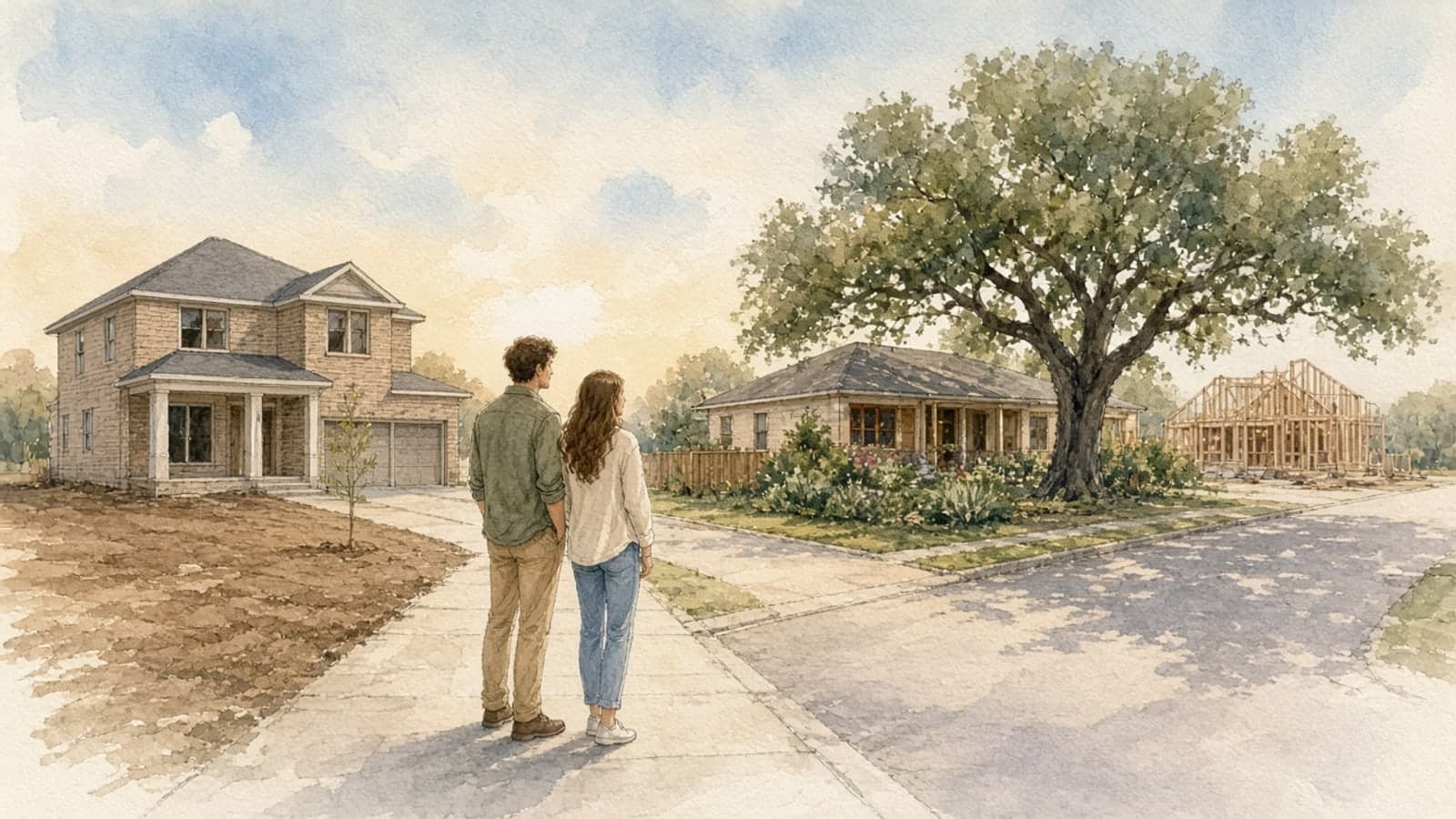
If you're shopping for a home around Houston, you'll usually end up choosing between a brand-new house from a builder and a resale home someone has already lived in. The two look similar on a listing site, but in Texas they come with different contracts, different disclosure rules, different warranty and defect rules, and different surprises on the first property tax bill. This guide walks through how to compare them side by side so the decision comes down to the house, not to whichever sales process felt easier. Everything below was checked on October 26, 2026.
TL;DR
- Texas has separate state contract forms for each path. The Texas Real Estate Commission (TREC) publishes a New Home Contract for incomplete construction (23-20), one for completed construction (24-20), and the One to Four Family Residential Contract (Resale) (20-19), all effective July 1, 2026. Builders often use their own contracts instead.
- A resale seller generally must give you a written Seller's Disclosure Notice about the home's condition. A new home that has never been lived in is exempt from that requirement under Texas Property Code Section 5.008(e)(10).
- Construction defect claims against a builder run through Chapter 27 of the Texas Property Code: written notice by certified mail at least 60 days before you sue, and a chance for the builder to inspect and offer repairs.
- Inside the City of Houston, new homes built in the 100-year or 500-year floodplain must be elevated to 2 feet above the 500-year flood elevation under the 2018 Chapter 19 rules. Older resale homes may have been built under earlier rules.
- HCAD values property as of January 1. A home that was incomplete on that date may be taxed at a lower value its first year and much higher the next, so budget for the finished value.
- Hire your own TREC-licensed inspector either way. Both TREC new home forms give the buyer the right to have the property inspected.
Start with the contract, because it shapes everything else
The biggest practical difference between new construction and resale in Texas is the paperwork. TREC's contracts page lists three forms that matter here, all effective July 1, 2026: the One to Four Family Residential Contract (Resale), form 20-19; the New Home Contract (Completed Construction), form 24-20; and the New Home Contract (Incomplete Construction), form 23-20. TREC says license holders are required to use its forms, but TREC forms are not the only contracts in circulation. Many builders sell on their own purchase agreements, which they write themselves.
The incomplete construction form is built around the fact that the house doesn't exist yet. It ties the seller to "Construction Documents," which it defines as the plans and specifications, finish out schedules, change orders and allowances. It requires every change order to be in writing, and it spells out how cost overruns on your selections are paid. It also has blanks for when construction must start and the date the home must be substantially completed, and it lets the builder substitute materials, equipment and appliances "of comparable quality." Delays from weather, casualty, strikes or unavailable materials extend the completion time, though the form says completion can never extend past the closing date.
The completed construction form reads much more like a resale contract. You can negotiate an option period, the property is accepted "as is" or with specific listed repairs, and the seller must assign any assignable manufacturer warranties to you at closing. Both new home forms also require insulation details (type, thickness and R-value), because Federal Trade Commission rules call for it.
If a builder hands you its own contract, read it as carefully as you would any of these, and compare it to the TREC forms so you can see what's missing. Things worth looking for are the completion date, what happens if it's missed, whether your earnest money is refundable, and how disputes are handled.
Disclosures: resale sellers owe you more information
On a resale home, Texas law gives you a detailed look at the seller's knowledge of the house. Texas Property Code Section 5.008 requires the seller of a single-dwelling residential property to give the buyer a written notice of its condition. If the seller doesn't deliver it by the contract's effective date, the buyer can terminate for any reason within seven days after receiving it. Our guide to the Texas Seller's Disclosure Notice covers what it asks.
That same section lists transfers that are exempt, and one of them is "a new residence of not more than one dwelling unit which has not previously been occupied for residential purposes." In other words, a builder selling a never-occupied home doesn't owe you that form. You still get information, but it comes from the contract itself, the plans and specs, the builder's warranty documents and your own inspections. Ask the builder in writing about anything you'd normally see on a disclosure: the lot's drainage, any known soil or foundation reports, and whether the lot is in a floodplain.
Defects and warranties
For a resale home, the condition you get is mostly what your inspection finds, plus whatever repairs you negotiate. The resale seller usually isn't a contractor, so your protection comes from the option period, the disclosure notice and the repair amendment. Our article on option money in Texas explains how that window works.
With a new home, the builder is the contractor, and that brings in Chapter 27 of the Texas Property Code, often called the Residential Construction Liability Act. Before you sue a builder over a construction defect, you must send written notice by certified mail, return receipt requested, at least 60 days before filing, describing the defects and sharing evidence such as reports and photos. During the 35 days after the builder gets that notice, it can ask to inspect the home, up to three times. It then has until the 60th day after receiving the notice to make a written settlement offer, which can be an offer to repair. If you reject an offer that turns out to be reasonable, the statute limits what you can recover. Section 27.007 requires contracts covered by the chapter to include a boldface notice about these rules, and you'll find that notice in the TREC new home forms. Section 27.009 says any attempt to waive the chapter in the contract is void.
Builder warranties vary by builder. The TREC new home forms say that, except as expressly set out in the contract, a separate writing or by law, the seller makes no other express warranties. That makes the builder's written warranty document the thing to read before you sign: what it covers, for how long, and how you file a claim.
Flooding and elevation in Houston
Flood rules are one place where newer homes can have a real edge inside the City of Houston. Under the Chapter 19 floodplain guidelines, the amendments the city adopted in April 2018 took effect September 1, 2018. New structures in the 100-year or 500-year floodplain must be elevated to 2 feet above the 500-year flood elevation. The Houston Permitting Center lists the inspections for a new single family home in the floodplain, including elevation certificates taken while it's under construction and again when it's finished.
That doesn't make every new home safe or every older home risky. The rule applies inside the city limits, and many new subdivisions around Houston sit in other cities or unincorporated areas with their own requirements. Plenty of older homes have never flooded, and some newer ones have. For any address, check the flood zone and history the same way, using our flood zone map guide. On a new build, ask for the elevation certificate. On a resale, ask whether one exists and what the seller's disclosure says about past flooding.
Property taxes: the first bill can mislead you
The Harris Central Appraisal District explains in Understanding the Property Tax Process that property is taxable at its January 1 market value. HCAD's data definitions guide shows how it handles construction in progress: a permit marked incomplete as of January 1 gets another inspection for valuation the following January 1. So a new home that was a slab or a frame on January 1 may have a first-year value far below its finished value, and the tax estimate on the listing can look low. Plan your monthly budget, and your mortgage escrow, around the finished value and the full tax rate.
Resale homes have their own catch. HCAD's capped appraisal values FAQ says the 10% homestead cap is based on the first year you qualify for a homestead exemption in your own name. The prior owner's capped value doesn't carry over to you. A resale home whose current taxes reflect years of capped value can be reappraised at market value for your first year.
Some new subdivisions around Houston also sit in a municipal utility district or a public improvement district, which adds another tax or assessment. Both TREC new home forms include notice paragraphs for these. See our guides to MUD taxes and Houston property taxes to run the numbers.
A side-by-side checklist
Use the same list on both kinds of home so you're comparing like with like:
- Total monthly cost. Price, the full finished-value tax estimate (including any MUD or PID), insurance and HOA dues.
- Contract terms. Which form is being used, the completion date, the option period, and what happens to your earnest money if things go wrong.
- Condition information. The Seller's Disclosure Notice on a resale. The plans, specs, warranty and your own phase inspections on a new build.
- Flood risk. Flood zone, flood history, and an elevation certificate where one exists.
- Lot and neighborhood. Mature trees and an established street versus a newer street where construction may continue for years.
- Inspection. A TREC-licensed inspector for either type. On a new build, consider inspections before drywall goes up as well as before closing. Our guide to what happens during a Houston home inspection covers the basics.
FAQ
Do I need a home inspection on a brand-new house?
The TREC new home forms give you the right to have the property inspected by inspectors you select who are licensed by TREC or otherwise permitted by law. Your own inspector works for you, not the builder. You can ask for inspections at stages during construction as well as a final one before closing.
Does a builder have to give me a Seller's Disclosure Notice?
Not for a new home that has never been occupied. Texas Property Code Section 5.008(e)(10) exempts it. A resale seller generally does have to provide one.
What if I find a defect after I move into a new home?
Read the builder's warranty and follow its claim process first. If it comes to a lawsuit, Chapter 27 of the Texas Property Code requires written notice by certified mail at least 60 days before you file, and gives the builder a chance to inspect and offer repairs.
Is new construction in Houston always above flood level?
No. Inside the City of Houston, new homes in the 100-year or 500-year floodplain must be built 2 feet above the 500-year flood elevation under the 2018 rules, but homes outside the city follow their local rules. Check every address.
Why are taxes on a new home sometimes so low the first year?
HCAD values property as of January 1. If the home wasn't finished on that date, the first year's value can be partial, and the full value shows up the next year.
Should I use my own agent when buying from a builder?
The salesperson in a builder's model home typically works for the builder. Having your own agent means someone reviews the contract and negotiates for you. Our guide to whether buyers need an agent in Houston explains how that works.
One last thing
Neither option is automatically the better buy. New construction trades history for unknowns about the contract, the timeline and the first real tax bill. Resale trades a finished, known house for older systems and whatever the inspection turns up. If you're weighing both in Cypress or elsewhere around Houston, start with our Cypress area guide, browse homes on our search page, or reach out and we'll compare specific houses with you.