
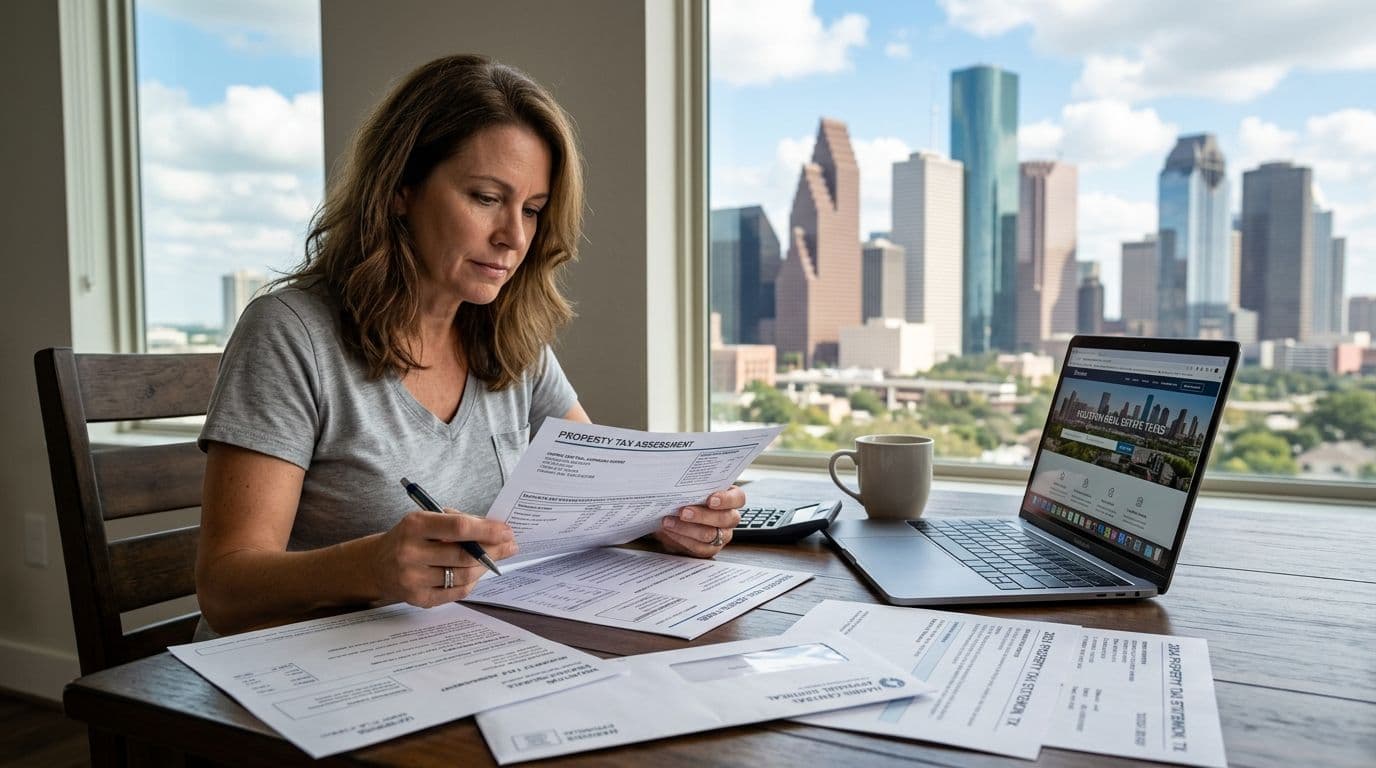
Houston real estate taxes typically run about 2% to 2.5% of a home's appraised value each year in 2026, depending on the city, county, school district, and any utility district that covers the address. That estimate leaves out one thing a lot of buyers miss: municipal utility district (MUD) or public improvement district (PID) fees, which stack on top of the base rate in many newer Cypress and Tomball subdivisions.
TL;DR
- Houston real estate taxes typically run 2% to 2.5% of appraised value in 2026, depending on your taxing jurisdictions.
- The $100,000 homestead exemption reduces your school district tax bill on a primary residence.
- Cypress and Tomball subdivisions often carry added MUD or PID taxes on top of city and county rates.
- You can protest your HCAD appraised value every year, usually by May 15 or 30 days after your notice.
- School district taxes are typically the largest single line item on a Houston property tax bill.
Why this matters
Texas doesn't collect a state income tax, so cities, counties, and school districts lean harder on property tax to fund police, fire, roads, drainage, and schools. That makes Houston real estate taxes a bigger factor in monthly affordability than in states where income tax offsets the load.
If you're budgeting for a home in Oak Forest, Garden Oaks, the Heights, Cypress, or Tomball, the tax line in your monthly payment can move your comfortable price range by tens of thousands of dollars. The Vital Realty Group team walks buyers through this math before they write an offer, not after.
This isn't a small line item you can ignore until closing. It shows up in your escrow account every month, and it changes when your appraised value changes or when a taxing entity raises its rate.
How much are property taxes in Houston?
Your Houston property tax bill is the sum of several separate taxing entities, each applying its own rate to your home's appraised value. No single number applies to every address because the entities overlap differently depending on where you live.
| Taxing entity | What it funds | Typical weight on your bill | |---|---|---| | School district (HISD, Cy-Fair ISD, Tomball ISD, Klein ISD, etc.) | Teacher salaries, facilities, debt service | Usually the largest single share | | City (Houston or your municipality) | Police, fire, streets, parks | Moderate share | | Harris County | Courts, roads, county services | Moderate share | | Harris County Flood Control District | Drainage and flood infrastructure | Smaller share | | MUD or PID (where applicable) | Water, sewer, neighborhood infrastructure | Additional, not universal |
School district taxes are typically the largest piece of a Houston-area bill, which is why the specific ISD your address falls in matters as much as the city or county. Check the Harris County Appraisal District (hcad.org) for the exact combined rate on any specific address, since rates are set annually by each entity.
Homestead exemption: $100,000 off your school tax bill
If the home is your primary residence, Texas law lets you file a homestead exemption that removes $100,000 of value from what your school district can tax. You apply through HCAD, and it stays in place as long as the home remains your primary residence.
The exemption also caps how fast your appraised value can rise for tax purposes on a homestead property, generally limiting increases to 10% a year even if market value jumps higher. That cap protects long-time owners in fast-appreciating areas like the Heights and Oak Forest from a sudden tax spike after a hot market year.
Missing this filing is one of the most common overpayments buyers make in their first year of ownership. File it the year after you close, and confirm HCAD has it on record before your first full tax bill arrives.
MUD and PID taxes in Cypress and Tomball
Many newer subdivisions in Cypress and Tomball sit outside city limits and were developed under a municipal utility district or public improvement district. These districts issue bonds to build water, sewer, and drainage infrastructure, then repay that debt through an added tax rate layered on top of the county and school district rates.
MUD rates are usually highest in a district's early years, while bond debt is fresh, and they decline over time as the debt gets paid down. A newer Cypress subdivision can carry a noticeably heavier combined rate than an established Oak Forest or Garden Oaks street with no MUD at all.
Ask for the specific MUD or PID rate on any Cypress or Tomball listing before you compare it to a home inside Houston city limits — the base sales price tells you almost nothing about the ongoing tax load.
Get local tax guidance before you offer
Vital Realty Group walks Houston buyers through the real tax math on any address.
Why Houston property tax bills vary
- Which city, school district, and county overlap your specific address
- Whether a homestead exemption is filed and up to date with HCAD
- MUD or PID debt attached to newer Cypress or Tomball subdivisions
- Over-65 or disability exemptions that can freeze school district taxes
- HCAD's annual reassessment of your home's appraised value
- Bond elections passed by your school district or utility district
Is Houston property tax higher than the rest of Texas?
There's no single 2026 ranking that puts Houston definitively above or below Dallas or Austin, because rates depend on the specific city, county, and school district within each metro, not the metro as a whole. The fair comparison is address-to-address, not city-to-city, since a Cypress MUD-heavy subdivision can carry a higher combined rate than a comparable home inside Houston's city limits.
Do renters pay Houston property taxes?
Renters don't receive a property tax bill directly, but landlords typically build that cost into monthly rent. A property with a heavy MUD or PID rate often carries higher rent to cover the owner's tax burden, even though the tenant never sees the HCAD notice.
How is my Houston home's appraised value determined?
HCAD reassesses value annually using comparable sales and market data, and that appraised value is what every taxing entity applies its rate against. If the number looks off compared to recent sales on your street, you can file a protest, typically by May 15 or 30 days after your notice is mailed, whichever is later.
FAQ
What is the property tax rate in Houston, TX?
Houston real estate taxes typically total 2% to 2.5% of appraised value in 2026, combining city, county, school district, and any MUD or PID rate. The exact figure depends on which taxing entities cover your specific address, so confirm the combined rate through HCAD before you budget.
How much does the homestead exemption save on Houston property taxes?
The homestead exemption removes $100,000 of your home's value from school district taxes if it's your primary residence. It also caps annual appraised value increases at 10% for homestead properties, which limits how fast your bill can climb in a rising market.
Do MUD and PID taxes apply everywhere in Cypress and Tomball?
No, MUD and PID taxes only apply to specific subdivisions built under those districts, not every home in Cypress or Tomball. Established neighborhoods inside city limits often carry no MUD rate at all, while newer developments outside city limits usually do.
Can I protest my Houston property tax appraisal?
Yes, you can protest your HCAD appraised value every year, typically by May 15 or 30 days after your notice is mailed. Missing that deadline locks in that year's valuation regardless of comparable sales data.
Are property taxes included in my mortgage payment in Houston?
Most Houston lenders collect property taxes through an escrow account as part of your monthly mortgage payment. Your escrow amount adjusts when your appraised value or a taxing entity's rate changes, which can raise or lower your payment even with a fixed-rate loan.
Do senior citizens get a property tax break in Houston?
Homeowners age 65 or older can qualify for an additional exemption and a freeze on school district taxes at the level from the year they turned 65. That freeze doesn't apply to county, city, or MUD taxes, which can still rise.
Why is my Houston property tax bill going up?
A rising bill usually comes from HCAD raising your appraised value, a taxing entity increasing its rate, or losing an exemption you previously had filed. Compare last year's notice line by line against this year's to see which entity changed.
Is Houston property tax higher than Dallas or Austin?
There's no fixed 2026 answer, since rates vary address by address within each Texas metro based on the specific city, county, and school district. Comparing two specific listings tells you more than comparing the cities as a whole.
One last thing
The HCAD protest deadline — May 15, or 30 days after your notice is mailed, whichever is later — is the single most overlooked date in Houston homeownership. Miss it, and you're locked into that year's appraised value even if three comparable homes on your street sold for less.
Buyers moving between Oak Forest, Garden Oaks, Cypress, and Tomball are often surprised that two homes at the same price carry very different tax loads once MUD or PID debt enters the picture. Veronica Miller and the Vital Realty Group team factor that difference into every offer strategy, not just the sale price. If you're weighing Houston real estate taxes against a specific address, reach out to Vital Realty Group before you write an offer, not after your first escrow statement arrives.