
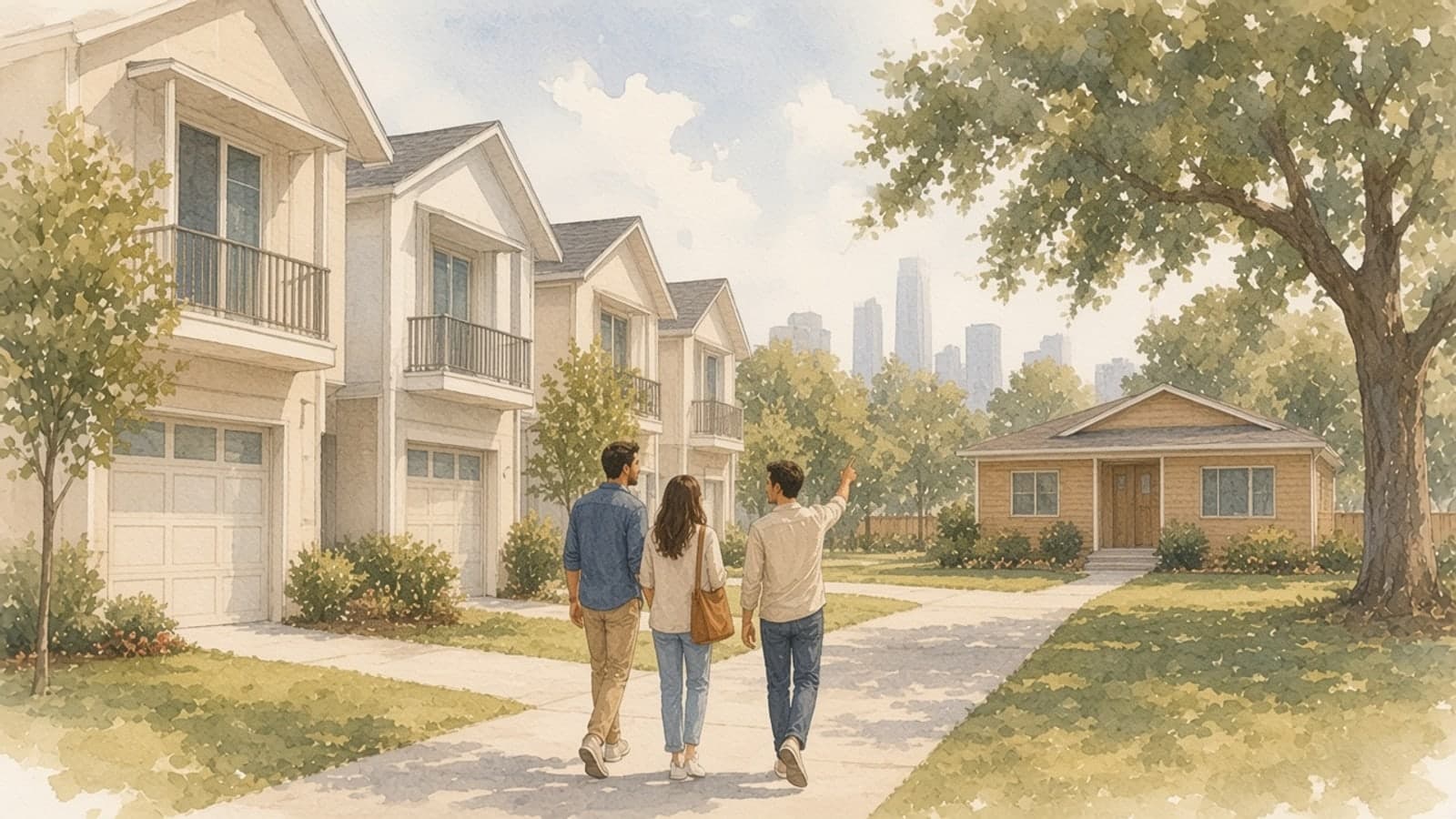
If you're shopping for a townhome inside the Loop or anywhere else in Houston, this guide covers the three things that make a townhome purchase different from buying a detached house: the association that may come with it, the walls you share with neighbors, and the small lot it sits on. It's written for buyers deciding whether a townhome fits and what to check before the option period runs out. Checked on October 30, 2026, against the Texas Property Code, the City of Houston's Chapter 42 lot-size rules, and the Texas Real Estate Commission's property owners association addendum. It's general information, not legal advice.
TL;DR
- "Townhome" describes a building style, not a type of ownership. In Houston a townhome is usually either a fee-simple house on its own small platted lot or a unit in a condominium regime, and the paperwork, insurance and association rules differ between the two.
- If the townhome is in a subdivision with a property owners association that can charge assessments, Texas Property Code Chapter 207 lets you get a resale certificate showing dues, special assessments, reserves, unpaid amounts, lawsuits and transfer fees.
- The TREC addendum for property with a mandatory owners association gives you a right to end the contract and get your earnest money back within 3 days after you receive the subdivision information, or before closing if that comes first.
- Houston has no zoning, but Chapter 42 sets lot sizes: 3,500 square feet is the minimum for a single-family lot inside the city, and smaller lots are allowed only under performance standards, including lots under 1,400 square feet that take access from a shared driveway.
- Shared walls and shared driveways mean someone other than you may be responsible for, or have rights over, part of what you're buying. Read the declaration and the plat, not just the listing.
- Insurance follows the ownership: Texas regulators say a townhouse policy may cover the interior only or the interior and exterior, depending on whether the association's master policy covers the exterior.
What you're actually buying when you buy a Houston townhome
The listing says "townhome," but the deed tells you what you own. In Houston you'll mostly see two setups.
Fee-simple townhomes on platted lots
Most newer inner-loop townhomes, the three-story rows you see in Rice Military, the Heights and near downtown, sit on their own small lots created by a subdivision plat. You own the building and the ground under it, the same as a detached house, just on a much smaller lot. Many of these communities have a property owners association that maintains a shared driveway, a gate, landscaping or drainage, and charges dues for it.
Condominium townhomes
Some townhome-style buildings are legally condominiums. Under the Texas Uniform Condominium Act, real property is a condominium only if one or more common elements are directly owned in undivided interests by the unit owners. In that case your "unit" is defined by the declaration, and things like exterior walls, roofs or the driveway may be common elements the association maintains. The same chapter says each unit is separately taxed and that homestead exemption laws apply to condo units the same way they apply to a single-family home.
The quickest way to tell which one you're looking at is to ask for the recorded declaration and look at the legal description. A condominium declaration has to include the word "condominium" in the name of the condominium. Your title commitment will also show the legal description and the recorded restrictions.
HOA dues, resale certificates and your right to walk away
Townhome buyers usually pay more attention to the association than detached-home buyers do, because the association often controls more of the property.
What a Chapter 207 resale certificate shows
For a subdivision with a property owners association that's entitled to levy regular or special assessments, Texas Property Code §207.003 requires the association to deliver, within 10 business days of a written request, a current copy of the restrictions, the bylaws and rules, and a resale certificate. The certificate has to include, among other things:
- the frequency and amount of regular assessments, and any approved special assessment that comes due after delivery
- the total of all amounts due and unpaid on the property
- capital expenditures approved for the current fiscal year and the amount of reserves, if any
- the current operating budget and balance sheet
- any unsatisfied judgments and the style and cause number of any pending lawsuit the association is a party to
- known violations of the restrictions on the property
- every fee tied to the transfer, who it's paid to and how much
The association can charge up to $375 to assemble and deliver the information and up to $75 for an update. Chapter 207 doesn't apply to condominiums; condo resale certificates are handled under Chapter 82.
The TREC addendum and the termination right
When the property is subject to mandatory membership in an owners association, Texas contracts use the TREC Addendum for Property Subject to Mandatory Membership in a Property Owners Association, form 36-10, which says on its face that it isn't for condominiums. You choose who obtains and pays for the subdivision information and by when. If you get it, you can end the contract within 3 days after you receive it, or before closing if that's sooner, and your earnest money is refunded. The addendum also sets a dollar cap on the association transfer fees and reserve deposits you'll pay, with the seller paying any excess.
Read the budget and the reserves line closely. A thin reserve with an aging gate, roof or private drive in the same community is a common source of special assessments.
Shared walls: what to check
A shared wall is the defining feature of a townhome, and it changes what an inspection and the documents need to cover.
- Who maintains what. For a condominium, unless the declaration says otherwise, §82.107 makes the association responsible for the common elements and each owner responsible for their own unit, including utility equipment and windows and doors serving only that unit. For a fee-simple townhome, look for a party-wall section in the declaration covering repairs, damage and access.
- Exterior changes. In a condominium, an owner may not change the exterior appearance of a unit without the association's prior written permission under §82.061. Many fee-simple communities have architectural rules too, so check before you plan a balcony cover or a new front door.
- Inspection scope. Ask your inspector to note anything at the shared wall, roofline, and flashing where units meet, and any signs of water moving between units. Our guide to what happens during a Houston home inspection covers what a standard inspection does and doesn't look at.
- Sound. No document tells you how a wall sounds. Visit at different times of day if noise matters to you.
Small lots, shared driveways and Chapter 42
Houston doesn't have zoning, but the City's Planning and Development Department reviews subdivision plats for compliance with Chapter 42, the land development ordinance. That's why inner-loop townhome rows look the way they do.
Under Chapter 42-181, the minimum single-family lot with wastewater service is 3,500 square feet inside the city and 5,000 square feet in the extraterritorial jurisdiction. Lots can be smaller only if the plat meets performance standards, such as compensating open space. A plat can include a lot under 1,400 square feet only if the property is inside the city, every lot in the subdivision takes vehicle access from the shared driveway or a permanent access easement, and the average lot size in the plat and on each blockface is at least 1,400 square feet.
The same chapter defines a shared driveway as a private roadway that gives access to two or more single-family lots through cross-access easements. In practice that means:
- the driveway behind or beside your garage is probably private, not a city street
- your access depends on recorded easements, which should show up on the plat and in your title commitment
- someone has to maintain, light and drain that driveway, usually an owners association, and its cost is in the dues
Ask for the recorded plat and look for plat notes. Chapter 42 requires certain small-lot plats to carry notations about future replats, and the plat is where easements and building lines show up.
Insurance and flood for townhomes
The Texas Department of Insurance's home insurance guide says townhouse insurance can cover either the interior and exterior of your townhouse or just the interior, depending on whether the homeowners association has a master policy that covers the exterior. Get the association's certificate of insurance (a Chapter 207 resale certificate includes one for the common areas) and give it to your agent before you choose a policy.
The same guide notes that most home policies don't cover flood damage, that lenders require flood insurance in a designated flood zone, and that more than half of homes flooded by Hurricane Harvey were outside designated flood zones. A ground-floor garage and entry is common in Houston townhomes, so check the address with our Houston flood zone lookup guide and read what flood insurance costs in Houston.
A townhome buyer's checklist
- Confirm whether it's fee simple or a condominium from the declaration and legal description.
- Get the subdivision information under the TREC addendum, and read the budget, reserves, lawsuits and transfer fees.
- Read the declaration's sections on party walls, exterior maintenance, leasing and architectural approval.
- Pull the recorded plat and look for shared driveway and access easements and plat notes.
- Match your insurance to the master policy, and price flood coverage either way.
- Search comparable townhomes on our Houston home search and, if you're looking in the Heights, start with our Houston Heights area guide.
FAQ
Is a townhome in Houston the same as a condo?
Not necessarily. Many Houston townhomes are fee-simple homes on their own platted lots. Others are units in a condominium regime. The recorded declaration and legal description tell you which.
Do all Houston townhomes have an HOA?
Many do, especially communities with a shared driveway, gate or common landscaping, but not all. The seller's disclosure and title commitment will show recorded restrictions, and the TREC addendum is used when membership in an owners association is mandatory.
How much can an HOA charge for a resale certificate in Texas?
For subdivisions covered by Property Code Chapter 207, up to $375 to assemble, copy and deliver the information and up to $75 for an updated certificate. Transfer fees are separate and must be listed on the certificate.
Can I back out if I don't like the HOA documents?
Under TREC addendum 36-10, if you receive the subdivision information you can end the contract within 3 days after receiving it, or before closing if that's earlier, and get your earnest money back. Watch that deadline; it's short.
Why are inner-loop townhome lots so small?
Chapter 42 allows single-family lots below the 3,500-square-foot city minimum when the plat meets performance standards, including lots under 1,400 square feet in subdivisions where every lot uses a shared driveway or permanent access easement and the average lot size is at least 1,400 square feet.
Who fixes the shared driveway?
Usually the owners association, under the declaration and the recorded access easements. Check the declaration and the association's budget to see who maintains it and how it's funded.
What insurance do I need for a townhome?
It depends on the master policy. If the association insures the exterior, you may only need an interior policy; if it doesn't, you'll need one that covers both. Flood is separate in either case.
One last thing
A townhome can be a good way to live close in for less upkeep, but most of what makes one a good or bad buy is in the documents, not the finishes. Get the declaration, the resale certificate and the plat early, read them during your option period, and ask questions before the 3-day window closes. If you'd like help comparing townhomes or reading an association packet, contact Vital Realty.